
On Friday 20 February 2026, the Diocese joined Catholic communities throughout Aotearoa New Zealand in observing the annual Day of Prayer and Penance for the Victims of Abuse and Violence. Held each year on the Friday after Ash Wednesday, the day calls the faithful to gather before God in humility, seeking forgiveness for the harm caused within our communities and praying for all who continue to carry the wounds of abuse.
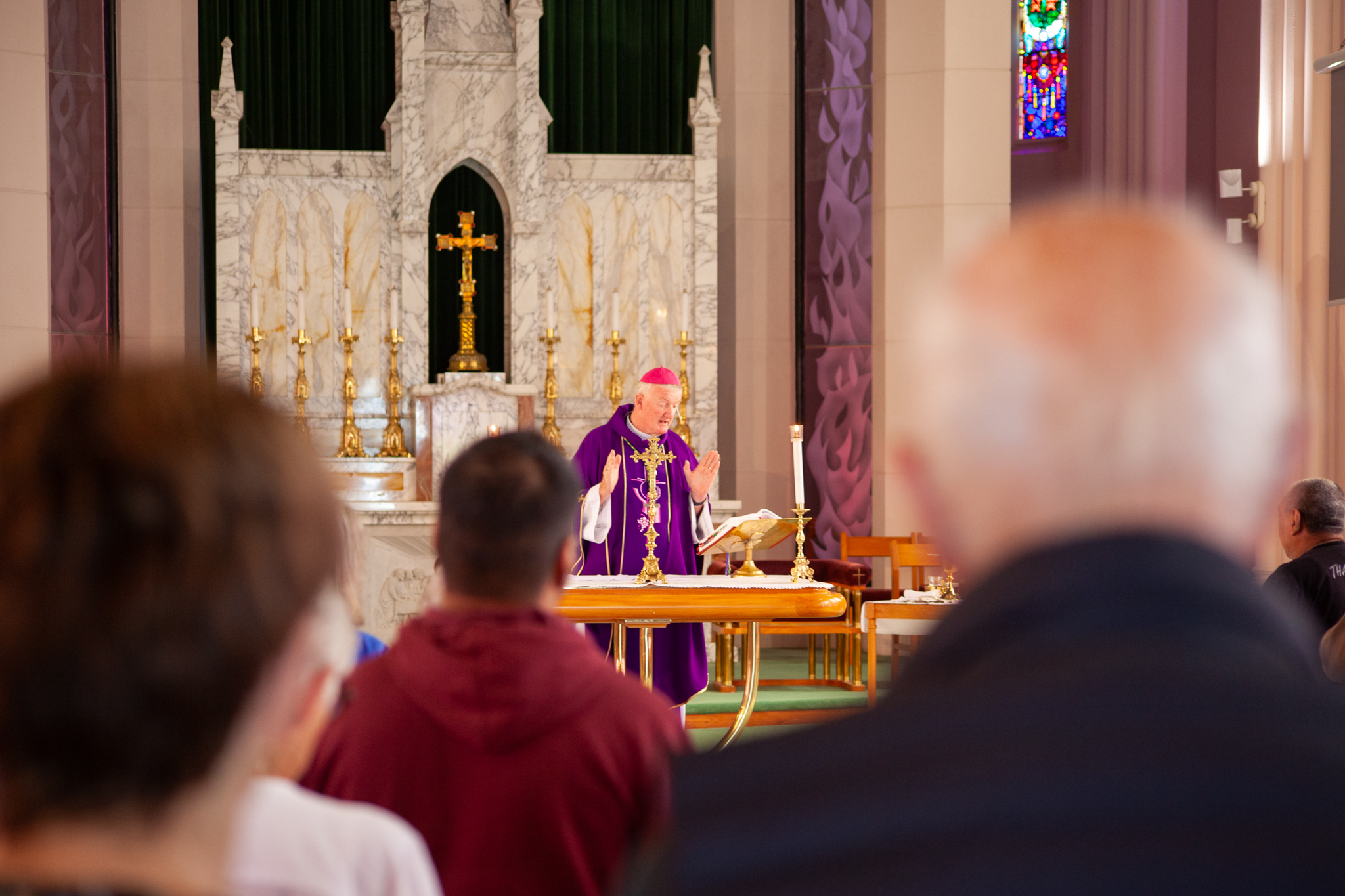 At the Cathedral’s midday Mass, Bishop John Adams offered the liturgy for survivors, holding them in prayer as the heart of the day’s intention. While his homily focused primarily on this call to pray for those who have suffered, he later spoke about the deeper significance of the day and the continuing responsibility borne by the Church.
In conversation afterward, Bishop John reflected candidly on the Church’s history. He shared that on that first Friday of Lent he offered Mass “for the reality that the Church has been a party to abuse” and acknowledged that “most of the complaints against the Church are upheld”. He emphasised that abuse often remains hidden for decades, yet its effects can shape a person’s life for a very long time.
Bishop John also spoke of the survivors he has met over the years — always with appropriate safeguards in place — and the pastoral listening the Church seeks to offer. Many survivors return more than once simply to be heard or reconnected with someone they trust. “There are some abuse survivors who come back several times just to see us,” he said, describing these encounters as meaningful and personal.
He contrasted this relational approach with the more procedural systems survivors may face elsewhere, noting that genuine human connection must remain central to the Church’s response.
What humbles him most, he said, is the perseverance of faith many survivors continue to show, even when their relationship with the Church has been deeply strained. “Often these people still have faith,” he reflected, adding that some express sorrow at having felt distant from Jesus yet still hold onto belief.
Bishop John did not shy away from acknowledging the failures that have contributed to this harm. He stressed that while abuse is not a problem exclusive to the Catholic Church, it is undeniably a problem within the Catholic Church. “The Catholic Church doesn’t turn men into abusers, but we have turned some abusers into priests,” he reflected sadly. He also noted that it is not only priests who have perpetrated abuse, but also members of religious orders — including, at times, women religious.
The Day of Prayer and Penance, he affirmed, is not simply a ritual observance but a crucial moment of honesty, solidarity, and commitment. It reminds the Church of its duty to listen carefully to survivors, to safeguard with vigilance, and to continually seek conversion in how it responds to those who have been harmed.
Above all, Bishop John urged the faithful to keep survivors in their prayers — not only on this designated day but throughout the year. Survivors’ trauma is often ongoing, he noted, and prayer is one essential expression of the Church’s desire to stand with them and work toward justice and healing.
If you or someone you know has been harmed by anyone acting in the name of the Catholic Church, support is available. Your story will be taken seriously and treated with confidentiality.
National Office for Professional Standards:
0800 114 622 | prof.standards@nzcbc.org.nz | www.safeguarding.catholic.org.nz
Further safeguarding information: www.pndiocese.org.nz/pastoral/safeguarding