
Please note: The reflections and opinions expressed in this piece are those of the author and are shared in the spirit of personal faith and contemplation. They do not necessarily reflect the official views of the Diocese of Palmerston North.
On Sunday 13 July, the Commission for Justice, Peace, Ecology and Development hosted a presentation by Katrina Mitchell-Kouttab, a Palestinian Christian actress, writer, and mother. Through her work and her voice, Katrina seeks to uplift the stories of her people and advocate for a future grounded in truth, humanity and hope.
Mary Eastham, a member of the JPEDC, reflects on the impact of Katrina’s words.
A New Generation Building a New Ethic of Solidarity, Justice and Peace
If we have lost someone close to us, we know that grief can give rise to greater compassion and love. But imagine the grief and loss experienced by the Palestinian diaspora, many of whom have watched in horror as over 57,000 lives have been lost since October 2023, including thousands of civilians. Then ask yourself the question: how can grief and loss of this magnitude build a new generation of solidarity, compassion, justice and love?
To an audience hanging on her every word, Katrina Mitchell-Kouttab proclaimed that this tragedy must give rise to a new ethic of solidarity, justice and peace, so that the suffering of those innocent civilians will not be forgotten or ignored. Katrina is a Palestinian Christian writer, mother, actress and advocate who deeply believes in peace, but peace rooted in truth, accountability and justice. Her family is from the Old City of Jerusalem in the Christian quarter, and she smiled as she recalled the baptism of her sons in the Church of the Holy Sepulcher, the holiest of Christian sites.
I cannot adequately summarise Katrina’s profoundly scholarly presentation. However, I can speak to three topics that point the way to how Christians, in solidarity with our Palestinian sisters and brothers, might become that new generation committed to building a new ethic of solidarity, justice, peace and love.
Genocide can never be justified
Since October 2023, the world has witnessed the unspeakable. Unfolding before our eyes on social media has been the relentless bombing of hospitals, residential homes, churches, mosques, schools in Gaza and the deliberate killing of civilians, mostly women and children. In addition, we have seen the deliberate targeting of journalists. It is difficult not to be moved by the looks of bewilderment on the faces of traumatised children. We know now that Gaza has the largest number of child amputees in recent history. We can only be appalled that basic humanitarian supplies have been blocked from entering into Gaza. We have been told by reliable media reports that starving people have been encouraged to line up in food distribution centres and then shot down in cold blood. Furthermore, thousands of Palestinians are now confined in extremely overcrowded and unsafe conditions in Rafah, under severe restrictions. Many human rights organisations and legal scholars have expressed concern that these events constitute serious breaches of international law, including crimes against humanity or even genocide.
Christians bearing witness to the Gospel of Jesus Christ can never be neutral to such stark violence.
The Church of Jesus Christ must stand with victims of “institutionalised violence”
Theologian Gustavo Gutiérrez coined the term “institutionalised violence” to describe systems that perpetuate inequality and suffering. Some voices have applied this concept to current events in Gaza, raising urgent questions about the responsibility of governments and military forces in conflict zones.
The Church of Jesus Christ proclaims the dignity of every human person (c.f. Dignitatis Infinita, the human dignity principle). Christians maintain that every human being is made in the image and likeness of God. Catholic Social Teaching proclaims the “preferential option for the poor” as a moral imperative. Are these just theoretical concepts, or do they begin to have meaning, given the real suffering of human beings in Palestine, the Holy Land?
The Church is a moral teacher in the public square. Now more than ever, the Church must stand with the Palestine people in their moment of anguish., and also with the many Israelis of good will who uphold the dignity of the human person and feel distress at the actions of their government against the innocent civilians of Gaza.
Political Zionism must be distinguished from Judaism as a faith tradition
It is important to make a clear distinction between Zionism and Judaism. While Zionism originated as a movement for Jewish self-determination, its political expression – particularly in the context of settlement expansion – has been criticised by many for its impact on the rights and land of the Palestinian people.
The historical aftermath of the Holocaust led to widespread international support for the establishment of a Jewish homeland. Tragically, this resulted in profound displacement and loss for the Palestinian people. The legacy of this unresolved tension continues to shape the region’s struggle for justice and peace.
Judaism as a great faith tradition is not the same as political Zionism. There are many Jewish people who condemn the actions of the current government of Israel and the war crimes being committed against the Palestinian people. With the banner, “Not in our name”, they refuse for the term anti-Semitic to be confused with anti-Zionism. They are righteous Jews who, in the name of their faith, have called out the current Israeli government for their war crimes against the Palestinian people.
To call out the war crimes of the current government of the state of Israel is not the same thing as anti-Semitism. The Jewish people do not have a monopoly on the word “semitic”. The Palestinian people speak a Semitic language. We should understand the importance of not confusing anti-Zionism with anti-Semitism.
Now is the Thyme for Action
Thyme for Action is a local social justice organisation who wrote a petition to the Palmerston North City Council because of the humanitarian catastrophe in Gaza. Following her presentation, Katrina asked us to consider signing the petition once we had read it for ourselves and agreed with the content.
Why? Because Now is the Time for all people of faith and none to speak up for justice and peace, which is an action to counter the genocide that is taking place.
The Petition to the Palmerston North City Council asks the Council to uphold International Law, Human Rights, and Ethical Procurement. It Calls for an immediate Ceasefire and Ethical Action for Palestine. It calls on the Council to take immediate action in line with international law, human rights, and community values. Those who signed the petition requested that Council:
Publicly call for an immediate, permanent ceasefire in Gaza and an end to the Israeli occupation of Palestinian Territories in line with United Nations resolutions and provisional measures issued by the International Court of Justice.
Adopt and implement an ethical procurement and investment policy that ensures Council does not enter into contracts or relationships with companies complicit in or benefiting from violations of international law, including illegal settlements on Palestinian land, in compliance with the Geneva Conventions, Genocide Convention, ICJ advisory opinion, and UN human rights treaties including UNSC Resolution 23343, to which New Zealand is signatory.
In conclusion, in my view, not to decide is to decide. Our moral conscience should be both informed and concerned. Living the Gospel of Jesus Christ means inaction or indifference is not an option. In the face of human suffering, even small acts of compassion, advocacy, and prayer can be powerful. And as the great man Ghandi once said: “When faced with any injustice, it is not important we do great things – but it is important we do something.” Therefore, in reading this, it is my hope that as disciples whose role is to proclaim the Kingdom, together we will use whatever means we have, small or large, to take a stand for justice and peace.
Mary Eastham
Diocesan Commission of Justice, Peace, Ecology and Development
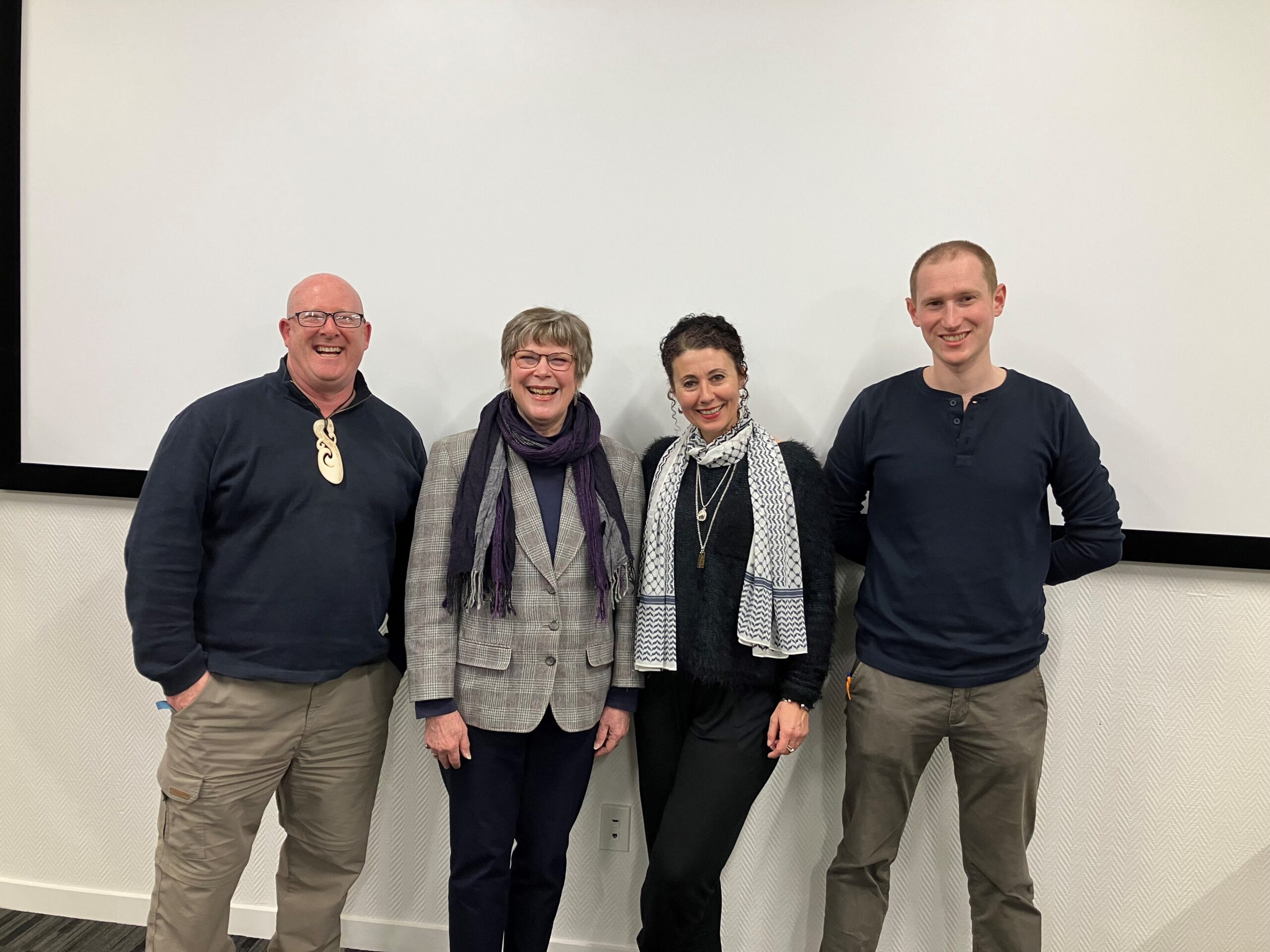
Members of the JPDEC with Katrina Mitchell-Kouttab, from left: Nick Wilson, Mary Eastham, Katrina Mitchell-Kouttab, Ben Schmidt