I’ll never forget the first time I climbed Mt Thomas, the closest mountain to my home in North Canterbury, which stands at just over 3,300 feet. The morning was gloomy and grey, and as my friend John and I jog-walked up the steep track leading to the summit, our beards became drenched by the dense mist that wreathed the mountain. With just a few hundred feet to go, the track emerges from the dense pine glade, curving around the western face, and there — as if waking out of a dream — we emerged from the mist into bright sunlight and found ourselves looking down on the white blanket below. It was truly an amazing sight, especially when we reached the summit shortly afterwards and marvelled at the full panorama, standing on an island in a sea of cloud.
“Mountain peak moments” are rare and precious as we journey together in our Catholic faith. The recent Diocesan Hub gatherings, which took place in Palmerston North and Hastings, provided an opportunity to come together to explore this faith and to open ourselves up to the presence of God. Our main focus was a passage on the presences of Christ, taken from the Vatican II document on the liturgy (Sacrosanctum Concilium, paragraph 7). At the heart of our gathering was the Conversation, where we came together in small groups, read the passage aloud, listened to the voice of the Holy Spirit, shared, listened again, and asked the Lord to draw us up into his light.
Some spoke of experiencing the Conversation as a personal encounter with God — a fulfilment of Jesus’ promise that “where two or three gather in my name, there am I with them” (Matt 18:20). Many spoke of their love for the Eucharist, “the greatest miracle,” and the joy of being invited to participate and receive. “Mass is a sanctuary for us, even though we are from different places,” and even though “we each have a different experience of God, Christ unites us.” Some saw the need to “bridge the gap” that can open up between the Church in its hierarchical structures and the Church as the one People of God. Others sensed the Spirit calling them to live their faith both “in the Church and out in the world” — to be witnesses of the presence of Christ to those who do not yet know him.
During the time of Q&A, some raised a difficulty with a particular word in the passage we had been discussing:
Christ is present… in the sacrifice of the Mass, not only in the person of His minister… but especially under the Eucharistic species. By His power He is present in the sacraments… He is present in His word… He is present, lastly, when the Church prays and sings…
It was the word “lastly” that prompted reservations. Was this suggesting that Christ’s presence among the people was of least importance?
In response, we explored how the different presences of Christ are ordered to one another. Why did God inspire the people of Israel and the Early Church to write the Scriptures? Why did Jesus institute the sacraments, and why does he desire to be present to us in the Eucharist? These signs and sacraments are given in order to fulfil a greater purpose. Will we still have the Scriptures and the sacraments in heaven? No. In heaven, these sacred signs will have fulfilled their purpose. The work that is begun now on earth will be perfectly complete. We, his people, will be bearers of his presence and temples of the Holy Spirit. What is last in the unfolding of God’s plan is actually the first thing he intended: “You will be my people and I will be your God.”
As the people of Israel journeyed through the wilderness to the Promised Land, they sometimes experienced God’s presence as a cloud descending upon the Tent of Meeting at the centre of the camp, or as a presence going before them as their guide. This is exactly what the Diocesan Hubs are all about. When we gather in his name, he is there with us and in us. As we listen to his voice, to one another, and to our own inner yearnings, we are drawn up through the gloom to new heights of unity and understanding. We behold — if only for a moment — the glorious plan that God has for us.
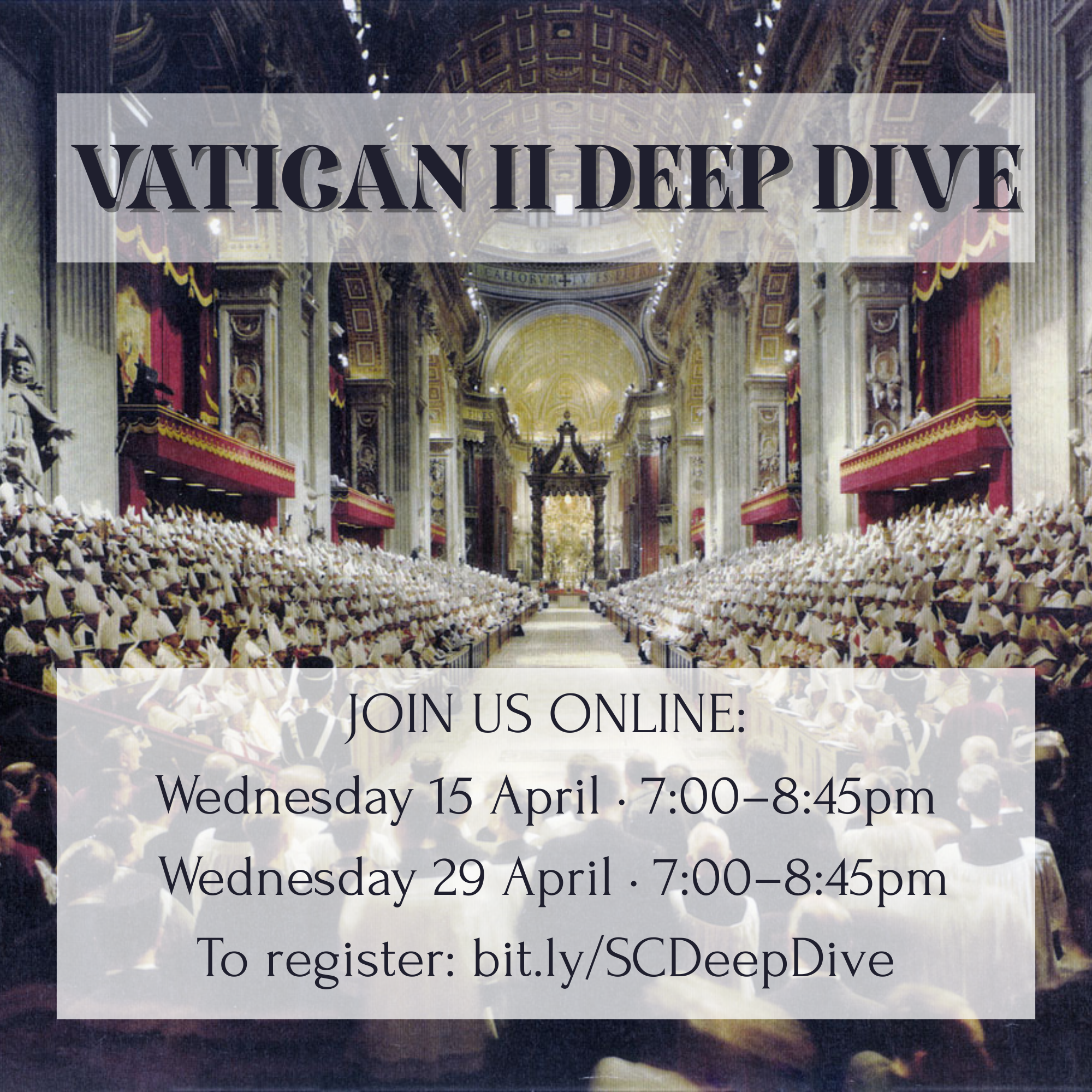
Whether you attended our first Diocesan Hub or not, I want to invite you to join me online for our Deep Dive sessions on April 15 and 29. There, we will continue to explore the riches of the liturgy in Sacrosanctum Concilium. I am also very excited about seeing you in person at our next Diocesan Hubs on May 30 (Whanganui) and May 31 (New Plymouth). There, we will turn our attention to another great document of Vatican II, Lumen Gentium, on the Mystery of the Church. The impact these documents continue to have on the life of the Church cannot be exaggerated, and we are truly blessed in this diocese to be formed and shaped by them as we journey together in faith.