
This diocese is a leader in the Hidden Disabilities Sunflower Scheme. In response to the synodal discernment of the diocesan community, responsibility for this initiative was incorporated into the diocesan role of Leader and Advisor for Inclusiveness, currently held by David Loving-Molloy.
David’s work is grounded in the field of disability theology, which explores questions of inclusion, participation, belonging, and welcome. Disability theology examines the relationship between the lived experience of people with disabilities and the sources of theological insight within the Christian tradition. It encourages us to break down barriers, see the world through different perspectives, and move beyond a distinction of “us” and “them” toward a shared understanding of “us.”
This article presents several theological principles that can guide a genuine and authentic consideration of disability within the Catholic intellectual tradition.
At one level, disability in all its forms should be regarded as an ordinary and natural part of human existence. It should not require special treatment, nor should it be viewed as something taboo. Yet the reality is that many people living with disabilities continue to experience exclusion, rejection, and marginalisation within communities, including faith communities.
Despite these challenges, there is significant potential for churches to become places of profound support and belonging. As Erik W. Carter observes:
“The potential for congregations to communicate grace, extend relationships, and share in the lives of people with a disability and their families in their community is enormous, but these rich and deep reservoirs of support remain largely untapped.”²
From a theological perspective, there is no basis for excluding people living with disabilities, regarding them as less than fully human, or viewing disability as a punishment from God. As John Swinton argues:
“Disability in all of its forms is simply another way of being human,”³
and
“a way of naming difference.”⁴
Several key theological principles are helpful when reflecting on disability.
The first is the doctrine of the Imago Dei (Image of God), which provides the foundation for any Christian understanding of the human person. Introduced in the Book of Genesis, we are told that all human beings are created “in the image and likeness of God” (Genesis 1:26–27). This principle affirms that every person – regardless of physical or cognitive ability, race, gender, language, culture, or any other characteristic – possesses equal dignity and worth. Every human life is to be respected, valued, and cherished without exception.⁵
A second principle is the theology of belonging, which is deeply rooted in Catholic social teaching. Swinton emphasises that communities should move beyond simply including people to creating genuine experiences of belonging:
“For a person to be present, they need to be missed.”⁶
He expands on this idea further:
“To belong you need to be missed. To belong, others need to long for you like the Prodigal Son’s father as he anxiously surveys the horizon, searching eagerly for signs of his son.”
Creating communities of belonging is central to the theology of disability. True participation requires more than providing services for people with disabilities; it calls for partnership and shared life. As David Loving-Molloy notes:
“A shift of mindset needs to occur from service for people living with a disability to service with people living with a disability.”
An essential mission of the Church is therefore to nurture communities in which every person is welcomed, valued, and able to participate fully in the life of the community.
In conclusion, through the Incarnation of Jesus Christ, all people share a common humanity. Disability is not something that places a person outside the community of faith; rather, it is one of the many ways in which human diversity is expressed. A truly Christian community recognises the dignity of every person, fosters a genuine sense of belonging, and enables all people to participate fully in the life and mission of the Church.
Endnotes
1 Zachariah (Zach) Duke is Senior Lecturer in Theology in the National School of Theology, Faculty of Theology and Philosophy, Australian Catholic University. Zach’s main areas of academic competence include: disability theology; practical-pastoral theology; ecclesiology and ethnography; and theological education.
2 Erik W. Carter, ed., Including People with Disabilities in Faith Communities: A Guide for Service Providers, Families, and Congregations (Baltimore, MD: Paul H. Brookes, 2007), 65.
3 John Swinton, “Interview with John Swinton,” 2013, accessed 15 January 2019, http://www.ucobserver.org/interviews/2013/02/john_swinton/.
4 John Swinton, “Time, Hospitality and Belonging: A Practical Theology of Disability” (public lecture, The Broken Bay Institute, Pennant Hills, June 24, 2014).
5 This is echoed in the opening lines of the Universal Declaration of Human Rights (1948): “all human beings are born free and equal in dignity and rights” (See United Nations, Universal Declaration of Human Rights, 1948, accessed 18 January 2019, http://www.un.org/en/documents/udhr/index.shtml).
6 Cristina Gangemi, ‘A Place to Belong: Stewards in a Human Story’ (available from c.gangemi@abdn.ac.uk).
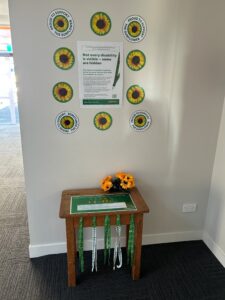
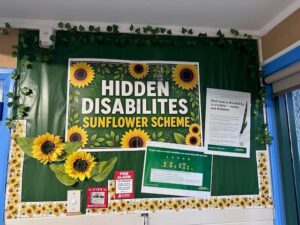
Hidden Disabilities displays at St Mary’s School Palmerston North (left) and St Anthony’s School Pahiatua (above)