Please note: The reflections and opinions expressed in this piece are those of the author and are shared in the spirit of personal faith and contemplation. They do not necessarily reflect the official views of the Diocese of Palmerston North.
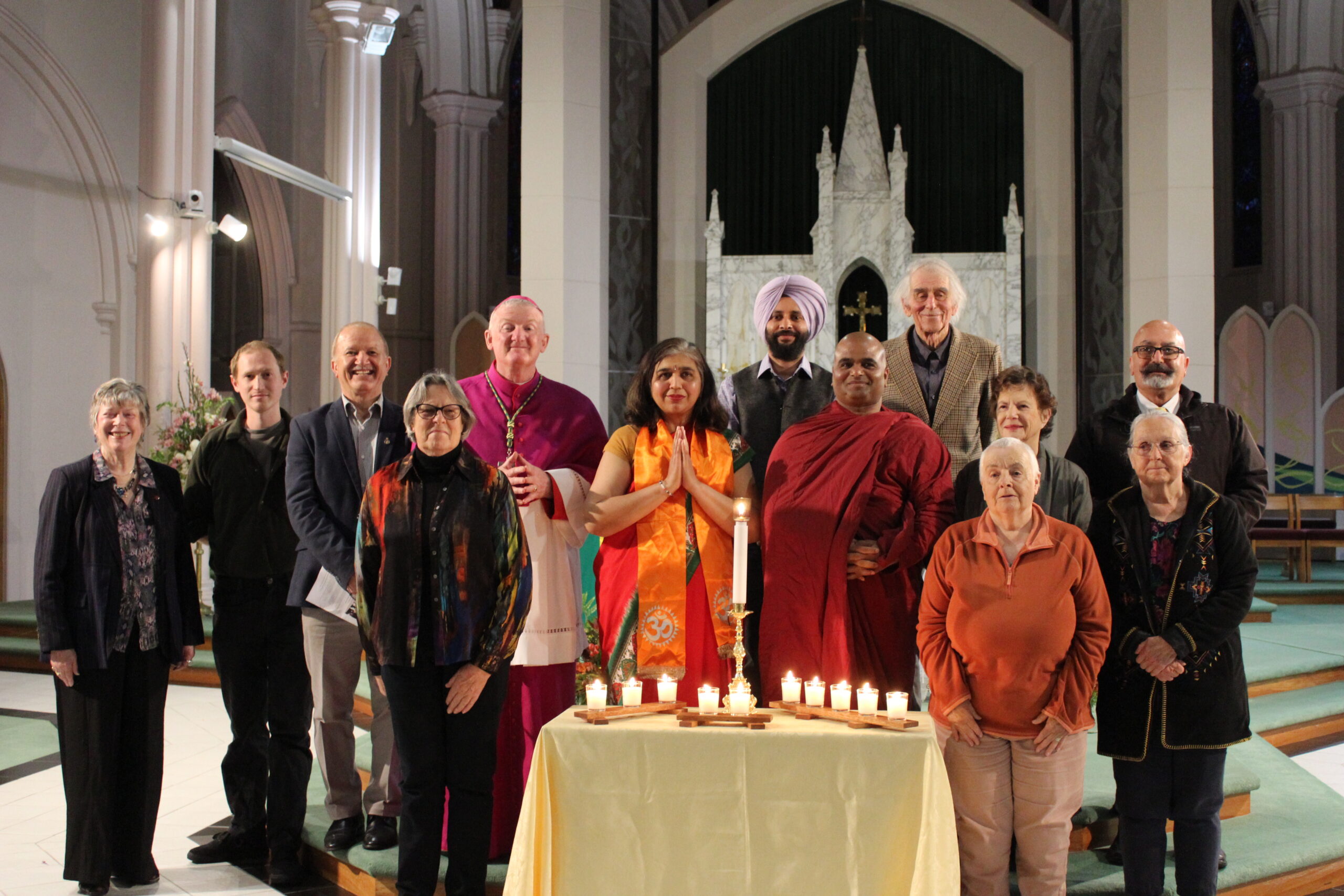
On 27 October 2026, faith leaders from the Baha’i, Buddhist, Christian, Hindu, Jewish, Muslim and Sikh communities gathered at the Cathedral of the Holy Spirit, Palmerston North, for the 40th anniversary of the Assisi World Day of Prayer for Peace.
From the moment deputy mayor Debi Marshall-Lobb performed the majestic Kaikaranga until the final blessing by Bishop John Adams, I could feel the “Spirit of Assisi”. The beautiful prayers by our interfaith family conveyed a sense of our common humanity despite religious and cultural differences. Their communal affirmation of peace in a world wracked by violence offered hope that people working together can encourage governments to pursue peace and invest in health, education and welfare.
The faith leaders each presented a unique prayer, chant, poem, song or meditation for peace from their religious traditions, then led the congregation in proclaiming the ten commitments of the Decalogue of Assisi for Peace to justice, peace and human dignity. To me, the interfaith leaders wove a tapestry of love, trust and co-operation, rooted in their commitment to their unique spiritual traditions. The Spirit of Assisi was alive and well at the Cathedral of the Holy Spirit. People were so eager to engage in a personal gesture of peace and connection that they leapt from their seats during the Sign of Peace in order to extend a personal greeting of peace to one another. I felt a sense of transcendence in the Cathedral: a profound sense of unity along with a profound appreciation for diversity. It was sublime.
There is something very sacred in hearing people pray and chant in their own ancient languages. Even more sacred, perhaps, is realising that these prayers for peace, justice and conversion have been prayed by thousands of people all over the world for many millennia. The lighting of a candle before prayer is a powerful symbol of light breaking through the darkness and filling the human heart with hope.
I feel that something wonderful happened at the 40th Anniversary of the Assisi World Day of Prayer for Peace at the Cathedral of the Holy Spirit. Humanity’s most precious aspirations for justice, peace, solidarity and equality were affirmed by ecumenical and interfaith leaders from the Baha’i, Buddhist, Christian, Hindu, Jewish, Muslim and Sikh communities. Christian celebrants included Catholic, Methodist, Presbyterian, the Religious Society of Friends (Quakers), and the Church of Jesus Christ of Latter-day Saints. When I learned that on 27 October 2018 in Pittsburgh, Pennsylvania, USA, a terrorist act of violence against the Jewish community took the lives of eleven people, I felt more committed than ever to affirm the values of peace, religious freedom and respect for religious diversity.
The first Assisi World Day of Prayer for Peace took place on 27 October 1986, when the world was reeling under the impact of international tensions caused by the Cold War. Its spirit continued in later gatherings, including the Day of Prayer for Peace on 24 January 2002, at which the Decalogue of Assisi for Peace was proclaimed. Its commitments to dialogue, mutual respect, justice and human dignity provided a framework for understanding the peace and solidarity we experienced at the Cathedral.
40 years after the first Assisi World Day of Prayer for Peace, I feel that the human family faces even greater challenges.
The suffering of innocent civilians reminds me how urgently international institutions are needed to uphold international law and protect human dignity. In a world marked by violence and injustice, the Decalogue of Assisi for World Peace offers a powerful call to renewed responsibility. Perhaps now more than ever, its message deserves to be heard in every church, synagogue, mosque and temple in the world.
The 40th Anniversary of the Assisi World Day of Prayer for Peace created an opportunity for the Diocesan Commission for Justice, Peace, Ecology and Development and the Palmerston North Interfaith Group to collaborate in a truly wonderful celebration of interreligious prayer and enrichment. As Pope Leo XIV reminded us in Magnifica Humanitas, interreligious dialogue plays a decisive role as a unique path to world peace:
In rejecting the mindset of violence, interreligious dialogue plays a decisive role, because at the heart of the great spiritual paths lies the message of peace. Whereas those who use the name of God to legitimize terrorism, violence or war betray his true nature, for to fight in the name of religion means attacking religion itself. The “spirit of Assisi,” evoked by Saint John Paul II and carried forward by Pope Francis—for example, through his dialogue with the Grand Imam Al-Azhar— shows that believers can draw up the most authentic sources of their particular spiritual traditions, where there is no room for “sanctified hatred”. (Leo XIV, Magnifica Humanitas 2026, #223)
I thank Bishop John Adams for initiating this event; special thanks also to Julie Randall, Bishop John’s representative on the New Zealand Catholic Bishops’ Committee for Interfaith Relations, for her enormous contribution both liturgically and socially. A heartfelt thank you to everyone who attended this beautiful interfaith celebration. I hope that the Spirit of Assisi, so alive that night, has carried over into our personal relationships and professional commitments, and will also permeate the network of social institutions that envelop our lives.
Mary Eastham is a lifetime member of the Palmerston North Interfaith Group, and a member of the Diocesan Commission for Peace, Justice, Ecology and Development.
Photo (below): Julie Randall
Decalogue of Assisi for Peace
- We commit ourselves to proclaiming our firm conviction that violence and terrorism are incompatible with the authentic spirit of religion, and, as we condemn every recourse to violence and war in the name of God or religion, we commit ourselves to doing everything possible to eliminate the root causes of terrorism.
- We commit ourselves to educating people to mutual respect and esteem, in order to help bring about a peaceful and fraternal coexistence between people of different ethnic groups, cultures and religions.
- We commit ourselves to fostering the culture of dialogue, so that there will be an increase of understanding and mutual trust between individuals and among peoples, for these are the premise of authentic peace.
- We commit ourselves to defending the right of everyone to live a decent life in accordance with their own cultural identity, and to form freely a family of his own.
- We commit ourselves to frank and patient dialogue, refusing to consider our differences as insurmountable barriers, but recognizing instead that to encounter the diversity of others can become an opportunity for greater reciprocal understanding.
- We commit ourselves to forgiving one another for past and present errors and prejudices, and to support one another in a common effort both to overcome selfishness and arrogance, hatred and violence, and to learn from the past that peace without justice is no true peace.
- We commit ourselves to taking the side of the poor and helpless, to speaking out for those who have no voice and to working effectively to change these situations, out of the conviction that no one can be happy alone.
- We commit ourselves to taking up the cry of those who refuse to be resigned to violence and evil, and we desire to make every effort possible to offer the men, women and children of our day real hope for justice and peace.
- We commit ourselves to encouraging all efforts to promote friendship between peoples, for we are convinced that, in the absence of solidarity and understanding between peoples, technological progress exposes the world to a growing risk of destruction and death.
- We commit ourselves to urging leaders of nations to make every effort to create and consolidate, on the national and international levels, a world of solidarity and peace based on justice.